

Fermented cocopeat,
grown with zero contamination.
Fermented cocopeat, grown from the coconut belt of Karnataka. Manufactured on a fully concreted, IIHR-protocol facility with a 7,000 MT annual capacity — from husk to bag, without a single point of soil contact.
7,000+
MT / year capacity
5
Acre facility
IIHR
Process protocol
Two decades in the coconut belt of Hassan
A small-scale enterprise established in 2005, primarily engaged in the manufacture of pulverised coco shell and coco charcoal. From 2022 onwards, the business expanded to produce IIHR-protocol fermented cocopeat.
Situated at Garudanagiri, 22 km from Arsikere and just 1.5 km from National Highway 69 — 220 km from Bengaluru.
Mr. G V Subramanya
Mechanical Engineer
25 years of experience in the coco-related business.
Mr. Yogeesh S G
Retired Mechanical Engineer
35 years of combined professional experience with SAIL, SESA GOA and Adani Ports at the senior management level.
0+MT
Annual cocopeat capacity
0acres
Manufacturing land area
0+years
Coco-industry experience
0%
Concrete-floor processing
What sets our cocopeat apart
Every stage of production is built around one goal: a consistently low-EC, contamination-free peat that performs the same way, batch after batch.
IIHR process protocol
Every batch of fermented cocopeat follows the process protocol laid down by the Indian Institute of Horticultural Research, Hesaraghatta.
Zero soil contamination
Discharge, fermentation and stockpiling all happen on concreted floors under shade, keeping the peat free of soil contact.
Coconut-belt sourcing
Husk is sourced from the local coconut-growing belt around Arsikere, which typically carries lower EC than coastal material.
7,000 MT annual capacity
A 5-acre facility with a 50,000 sq ft concrete floor lets us produce and stock cocopeat at meaningful scale.
Built for growers who can't afford inconsistency
Water retention on demand
Ensures plants have access to water even during dry spells, reducing the risk of crop failure.
Superior aeration
Unlike traditional soil, our cocopeat carries excellent aeration properties for healthier root zones.
Zero soil compaction
Prevents compaction, allowing for better root development and oxygen uptake by plants.
Reliable bulk supply
A 7,000 MT annual capacity backed by concrete-floor stockpiling for consistent, on-time dispatch.
From fermented cocopeat to coco shell
Two product families, both sourced from the same coconut belt and processed at the same facility.
Fermented Cocopeat Block
Low-EC, IIHR-protocol fermented cocopeat, compressed into blocks for efficient storage and freight.
- EC< 0.5 dS/m
- pH~6.5
- Moisture~70%
Fermented Cocopeat (Loose)
Unwashed, low-salt fermented cocopeat supplied loose for large-volume horticulture and landscaping use.
- EC< 0.5 dS/m
- pH~6.5
- Moisture~70%
Pulverised Coco Shell
Finely pulverised coconut shell, a legacy product of the business since 2005, used across industrial applications.
- FormPulverised / powdered
- SourceLocal coconut-belt husk and shell
Coco Charcoal
Coconut-shell charcoal produced at the same facility, sourced from the same coconut belt.
- SourceCoconut shell
Husk to bag, on concrete every step of the way
Our process conforms to the standard recommended by the Indian Institute of Horticultural Research, Hesaraghatta, Bengaluru.
Husk sourced from the coconut belt
Husk is procured from the coconut-growing belt around Arsikere and Hassan. Material from this hinterland region typically falls under lower EC compared to husk from the coastal areas.
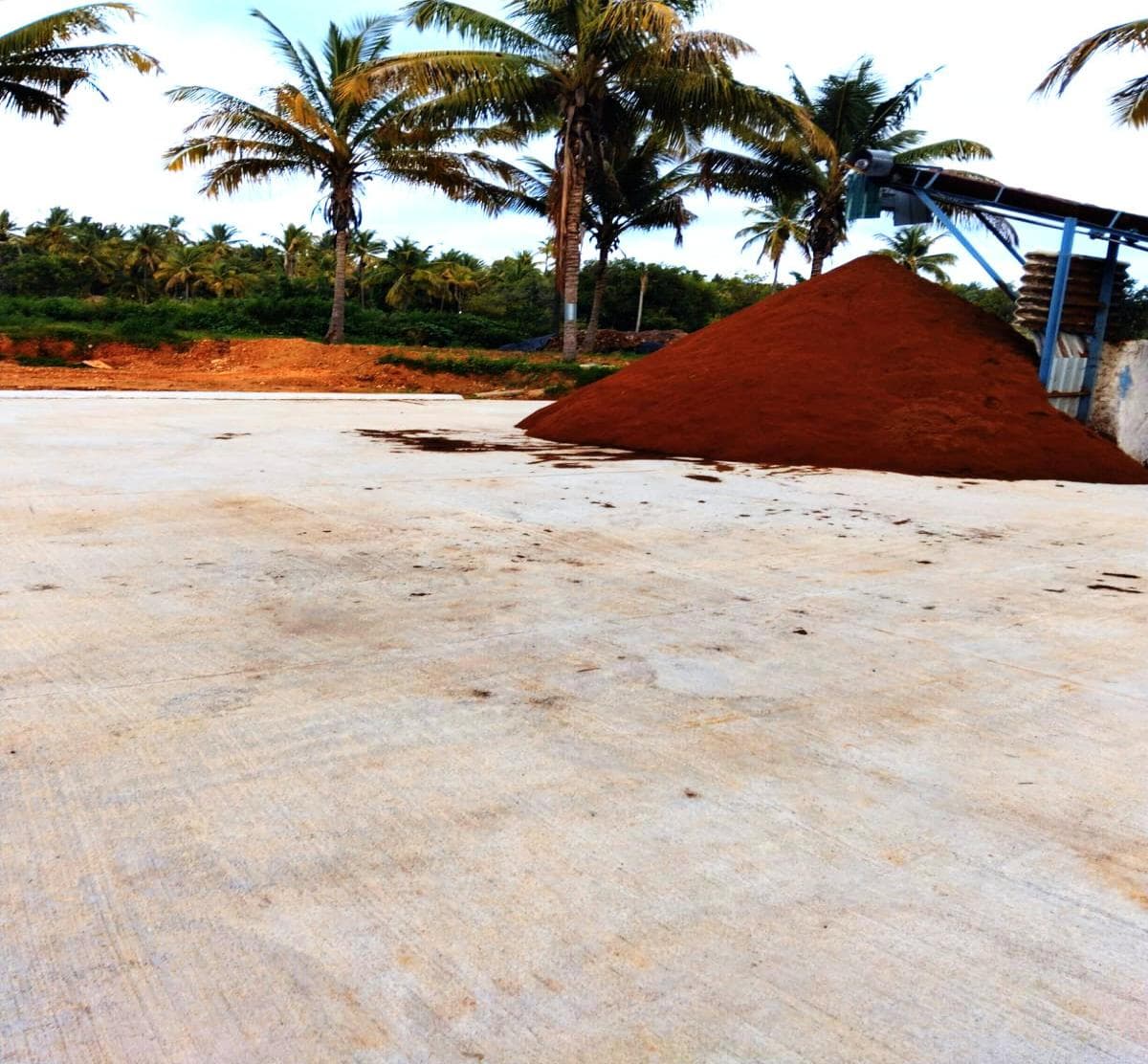
Pith discharged onto concrete
The pith discharged from the conveyor falls directly onto a fully concreted floor, preventing any contact with soil from the very first stage of processing.
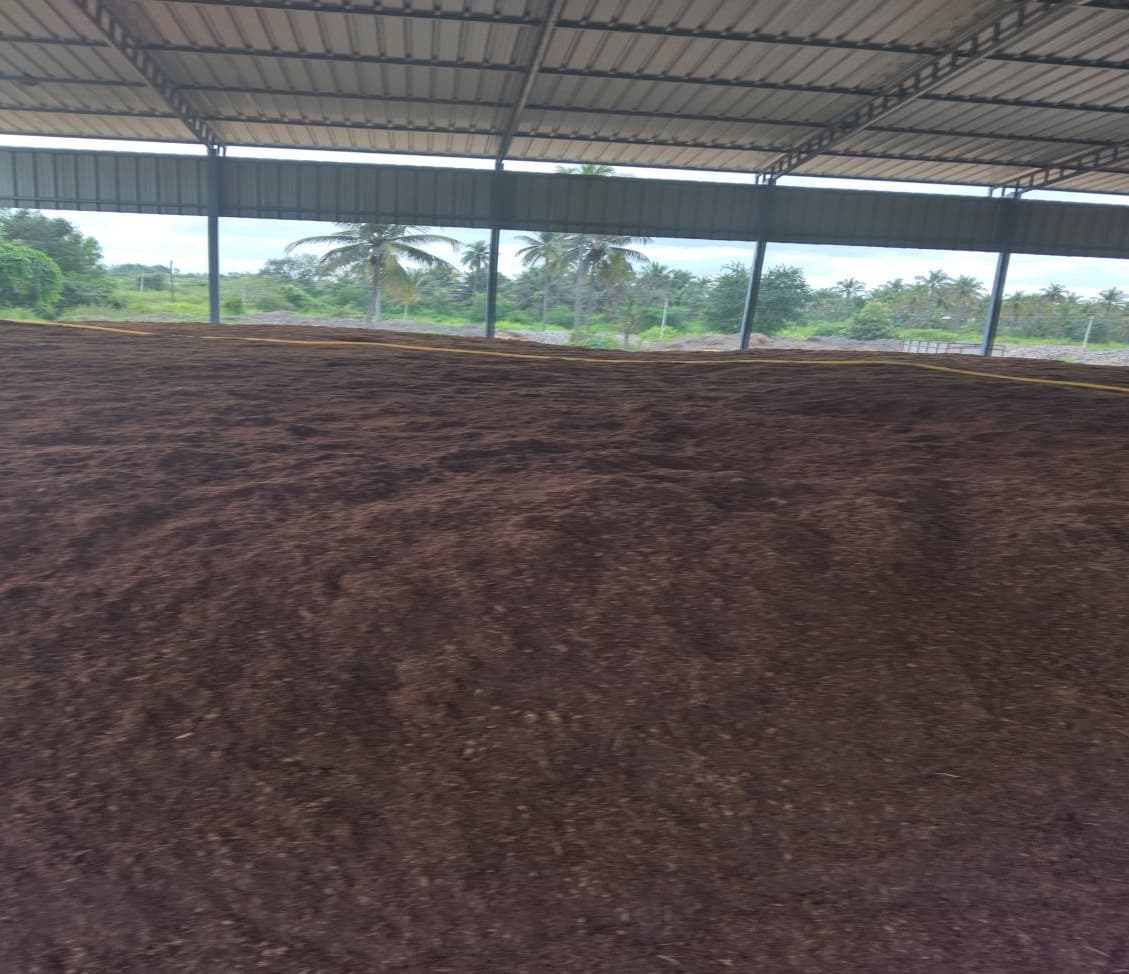
Fermentation under controlled shade
The pith is fermented under controlled conditions of shade, on a concrete stockpile floor, for zero contamination — following the IIHR, Hesaraghatta process protocol.
In-house quality testing
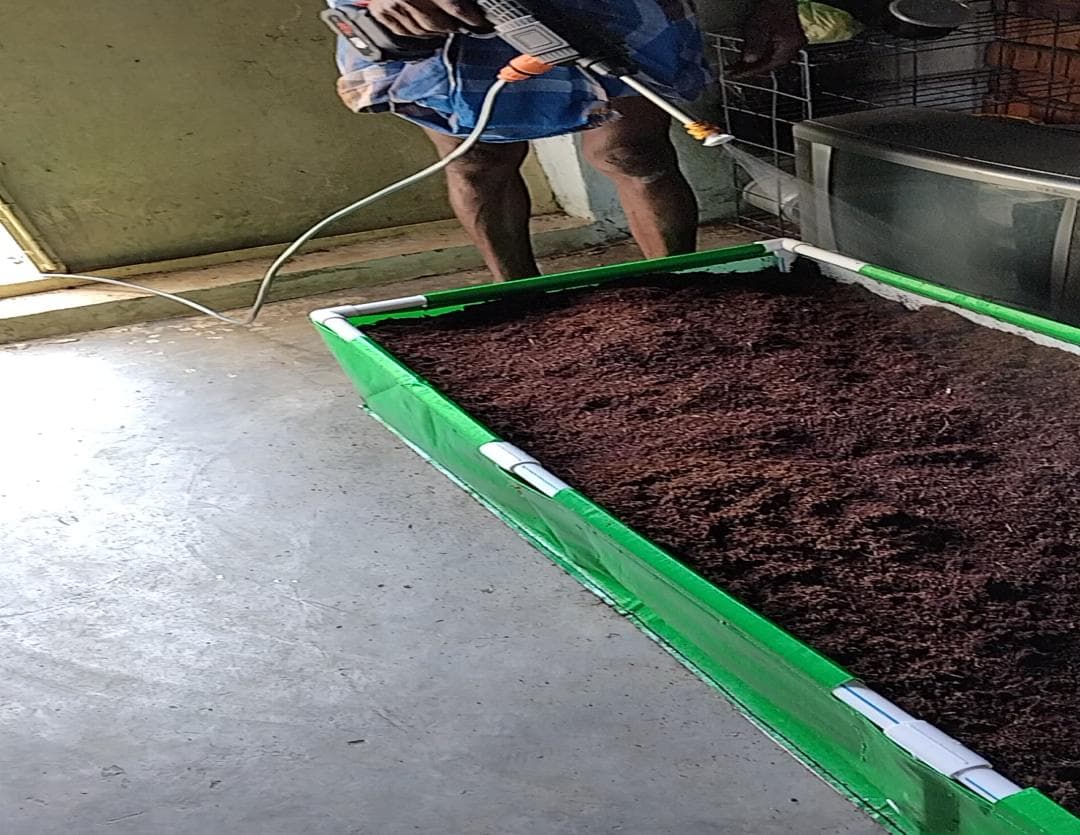
Representative samples are prepared and tested for EC, pH, moisture and temperature to confirm conformance to IIHR specification before any batch is released.
Baled, bagged and dispatched
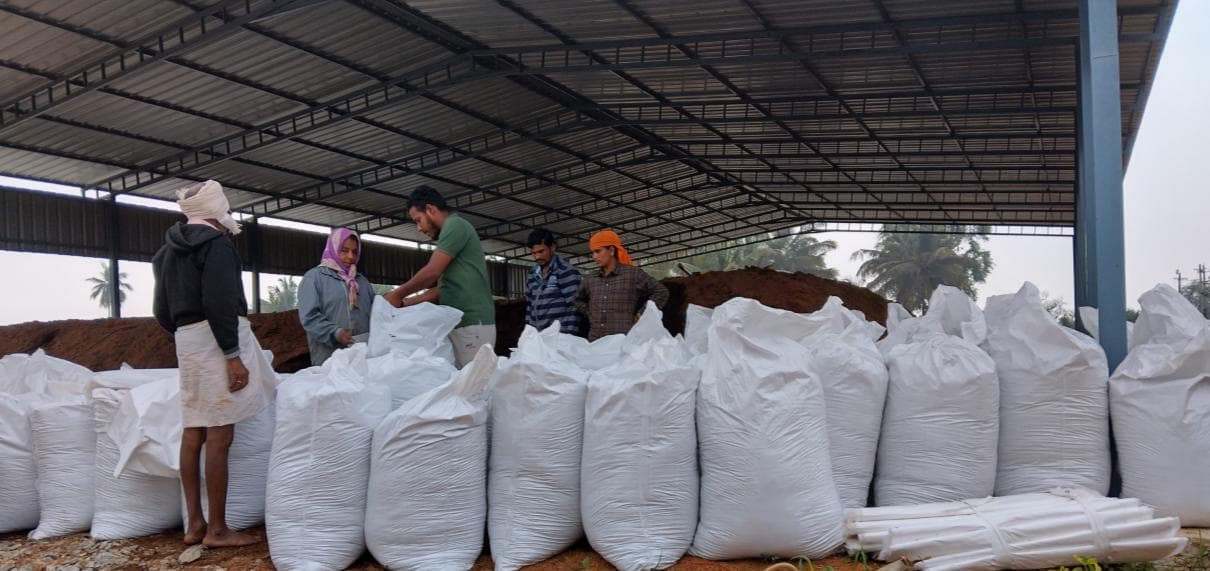
Finished cocopeat is compressed through the fibre baling press, bagged, and dispatched in blocks, bulk bags or loose bulk loads as required.
A 5-acre, fully concreted production yard
Situated 22 km from Arsikere and 1.5 km from National Highway 69, the plant is built to keep every stage of processing off bare soil.
- Land area
- 5 acres
- Concrete floor area
- 50,000 sq ft
- Mobile equipment
- 60 HP front-end loader, tractor, 10T truck
- Plant equipment
- Buster, beater, conveyors, screens, fibre baling press
- Workshop
- Well-equipped in-house workshop
Scaled to supply bulk, consistently
The plant has the capacity to produce 7,000 metric tonnes of cocopeat annually, with peat produced under controlled conditions of shade and on concrete floor to eliminate soil contamination.
0
Metric tonnes produced annually
0
Sq ft of concrete floor for processing
0 km
From Bengaluru via NH 69
Tested before it ever leaves the yard
Every batch is verified against IIHR specification using our in-house testing facility.
Electrical conductivity (EC)
< 0.5 dS/m
pH
~6.5
Moisture
~70%
Process standard
IIHR, Hesaraghatta process protocol
| Parameter | Instrument |
|---|---|
| EC | Hanna instrument |
| pH | Standard pH instrument |
| Moisture | Standard moisture instrument |
| Temperature | Standard mercury thermometer |
What cocopeat does for your crop
Consistent water access
Ensures plants have access to water even during dry spells, reducing the risk of crop failure.
Improved aeration
Unlike traditional soil, cocopeat has excellent aeration properties for stronger root systems.
No soil compaction
Prevents soil compaction, allowing for better root development and oxygen uptake by plants.
Trusted across horticulture and agriculture
Nurseries & Horticulture
Seedling raising and potting media for commercial nurseries.
Cocoponics & Soilless Farming
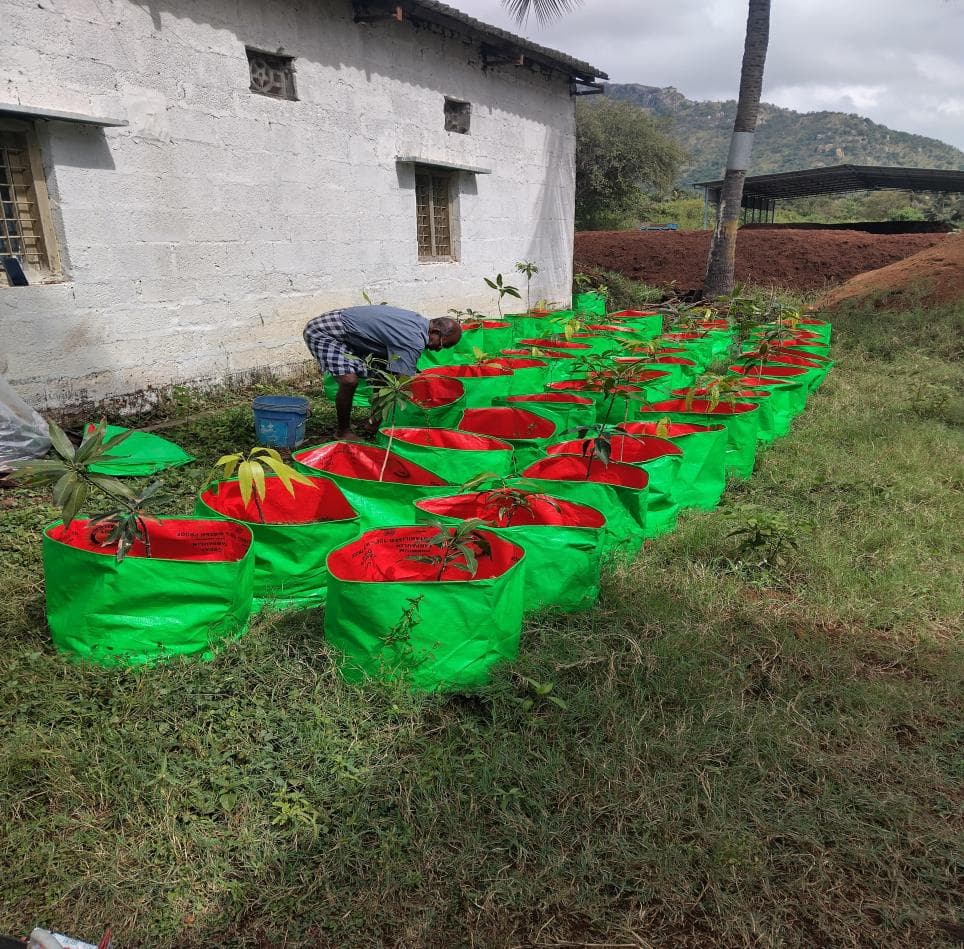
Trialled with lemon and other saplings under the IIHR-suggested cocoponics method.
Landscaping & Turf
Soil conditioning and bedding material for landscaping projects.
Export & Bulk Trading
Bulk supply for domestic distributors and export-oriented buyers.
Two decades of building on the coconut belt
2005
Sri Sai Charcols is established
Founded as a small-scale enterprise manufacturing pulverised coco shell and coco charcoal.
2022
Cocopeat production begins
The business expands into fermented cocopeat, adopting the IIHR, Hesaraghatta process protocol.
Today
7,000 MT annual capacity
A 5-acre, fully concreted facility in Garudanagiri supplies cocopeat and coco shell products at scale.
Registered, protocol-conformant, and transparent
IIHR Process Conformance
Fermented cocopeat conforms to the Indian Institute of Horticultural Research, Hesaraghatta process protocol.
GST Registration
GSTIN 29BQFPG7006Q1ZD
Udhyam Registration
UDHYAM-KR-09-0016246
Common questions from buyers
We manufacture fermented cocopeat that conforms to the process protocol of the Indian Institute of Horticultural Research (IIHR), Hesaraghatta, Bengaluru — from pith discharge through fermentation to bagging.
Ready to source cocopeat at scale?
Tell us your quantity and delivery location — we'll get back with pricing and lead time within one business day.
Let's talk about your requirement
Reach out directly, or send an enquiry below and our team will respond with pricing and availability.
Call Us
+91 96324 62555
+91 90990 05255
Email Us
srisaicharcol123@gmail.com
Visit the Factory
52/P5, M. Mallenahalli, Garudanagiri, Hassan Dist, Karnataka 573112
Business Hours
Monday – Saturday
9:00 AM – 6:30 PM IST